Thursday, April 14, 2011

Brilliant Incompletion

It’s difficult to create an alternative universe and depict how it works without having to explain or signpost it. Some sort of isolation usually comes into play, as is the case with this profoundly disturbing film. 

A bunch of children attend a rural English school and all is seemingly normal. There’s even a date to tell us we’re in the “real” world: 1978. Sure, there aren’t any male teachers, but that generally doesn’t apply to schools for young children anymore. Non-paedophile males generally don’t want to work with those ages, especially not at those salaries.

Director Mark Romanek makes a point of dwelling on the exquisite innocence of these children as they sing a hymn. It’s all so very English. Their principal is the still-divine Charlotte Rampling, but many of us cannot help remember her playing a woman who becomes turned on by her Nazi torturer conducting various “scientific” experiments on her in The Night Porter.

Children from Hailsham are special, she says. And we see how special they are by the fact that they wear electronic bracelets on their wrists. They are being monitored. Why? It takes a feeling teacher, played by the ever-impressive Sally Hawkins, to tell them that they will become organ donors. They will not lead normal lives. They will make two or three donations and then they will complete, the most terribly ironic euphemism for dying. They will die young.

The problem is they don’t understand. They see this as normal. But it’s a moot point that they are so brainwashed that they do not rebel against this unnatural order of things, especially later when Tommy (Andrew Garfield) and Ruth (Keira Knightley) start having sex. Surely they would want this to continue? Surely they would look around them and see that others have children. Surely they would want children later on, whether with each other or not? Surely they would want to know where their parents are?

Granted, it transpires later on that they come from the dregs of society. They are the unwanted children of junkies and prostitutes, but that wouldn’t necessarily put them off wanting children of their own. Some people desperately want to create what they did not have. There is no indication that any kind of enforcement takes place.

There are small uprisings. Tommy, for example, has a natural temper. He also happens to be a good artist, one of the few times that someone’s art on screen comes across as uniquely theirs.

Sure, they are kept in the country and in country houses, but they still have access to TV and porn magazines. They see other people getting old. It’s not like the whole world is like this. Surely this should lead at least one of them to want to go into the bigger, wider, outside world? Would their loyalty to each other be so strong that they’ll stick together, regardless? Can social brainwashing be so powerful? Perhaps.

But maybe it doesn’t matter, for if this film is not that successful a description of an alternative universe or dystopia then it is a strikingly original and painfully truthful metaphor for this one, English and beyond.

The three main characters’ innocence as adults is as shattering as seeing your own parent being unable to understand that they’ve just been given a death sentence by a neurologist. Tommy, Kathy and Ruth don’t know, for example, how to order food at a takeaway restaurant. And they are human enough to betray each other, as is so often the case in romantic triangles.

The photography and performances are all extremely fine, and I take back anything I ever said or thought about Knightley as an actress. Her post-operative speech, limping down a hospital corridor with the friend she betrayed, is a masterpiece of physical and existential shame.

It may all sound depressing, but seeing these beautiful young people going wide-eyed to their ends forces us to ask ourselves whether we are complete, now, and whether we will be the day we do just that: “complete”.

Neil Sonnekus

Friday, April 8, 2011

Crossing the Cultural Himalayas

Matt Whelan and Michelle Ang.
Cross-cultural dramas and comedies have probably become increasingly popular because people are increasingly migrating to other places where they can be safer, better off and happier.

In the case of The Names of Love we are in France, where a dry zoological scientist, whose job it is to monitor possible outbreaks of bird flu, tries to hide his Jewish roots, whereas a gamine woman flaunts her Arabic ones - and her body.

This is because she was abused as a child by her French piano teacher and has become so scatty that she forgets to get dressed one fine day and walks naked down the road - she conveniently has shoes on - talking on her cellphone.

She would, of course, end up sitting opposite a strictly covered-up Muslim couple, burqa and all, on the train. After this episode, however, she is never absent-minded again.

Anyway, the film takes a while to get going as the two leads introduce their pasts to us, sometimes talking directly to camera, and the present and younger versions of themselves interacting with each other.

The school pupil Arthur Martin (Jacques Gamblin) makes a very good and possibly very Jewish point - his name is deliberately neutral - that maybe Jews don’t want to be commemorated on plaques for just the most miserable moments of their lives. Why not the happiest times?

Bahia Benmahmoud (Sara Forestier) also makes the point that not all Muslims are exactly the same, but it is her father who comes across as the more convincing character. Zinedine Soualem, who resembles a younger Cat Stevens, plays a man who has heaps of artistic talent but is more obsessed with doing any odd job to pay the rent. It didn’t help much seeing and sketching his grandfather being shot dead by French troops in Algeria.

Equally moving is Arthur in one of those anti-bacterial suits, standing in a dam with a dead white swan in his hands, getting a phone call and being told by his emotionless father that his mother has died.

If the film doesn’t all quite hang together at times, and even becomes a little didactic politically, it is at least a light, intelligent look at a somewhat heavy problem.

More of the same can be found in the ultimately charming local film, My Wedding and Other Secrets.

Here the conflict lies in the highly ambitious Emily Chu (Michelle Ang) falling in love – horror of horrors – with a white New Zealand boy, a Pakeha. This won’t do as far as her strict Chinese father is concerned, or at least so she thinks.

If she marries a whitey she'll be disowned. This leads to all kinds of complications, including never being able to sleep over at James's, even after they have secretly married.

But there’s another big and rather touching visual difference between them. James (Matt Whelan) is a tall, Edmund Hillary-like beanpole and Emily is vertically challenged. In short, short. If she is clearly an alter ego of her writer/director/producer, whose steely and possibly migrant determination shines through in more ways than one, then he is a dreamy computer games designer with two goofy mates one wishes were evident in Love Birds.

In fact, the characters all round are superbly drawn and Liang makes a feast of sending up Chinese kitsch – including kung fu movies - without once being patronising. If also a tad slow initially, it is still a satisfying romcom that is deservedly doing good business at the box office and bodes well for Ms Liang’s cinematic future.

Neil Sonnekus

Thursday, March 31, 2011

Cast in Stone


Flight Over the Tamaki, by Don Guy
I couldn’t drive to the cinema because my car licence had expired and it would cost me $200 if I was fined, like my wife had been for going over the limit – by a day. The powers that be would not negotiate, like you can in, say, Africa. She would pay the amount and that was that.

So it was off to the video store and there was a film I hadn’t heard of before, but it was starring Edward Norton and Robert De Niro. They had collaborated on The Score in 2001, a heist movie more memorable for Norton’s chameleonic skills and a fine jazz score by Howard Shore than the story – or even Marlon Brando’s weighty cameo.

Moreover, it was the same director, John Curran, who had made The Painted Veil with Norton in 2006. Based on a Somerset Maugham story and set in China, it was a drama that was as solid as it was unfashionable in these rather shrill times.

So, too, Stone. De Niro plays Jack, a parole officer who is essentially a hollow man. He does not believe in anything, he doesn’t know why he’s unhappy, and he’s not going to do anything about it. He doesn’t seem to hear the debates about free will, religious freedom and the right to bear arms on his car radio, though he does carry a little .38 snubnose.

By contrast, one of his potential parolees is starting to hear sounds. Norton plays the prisoner, Gregory, with just the right ambiguity. He could truly be hearing the sound that makes you become “God’s tuning fork”, or he could be softening Jack up to write him a favourable report.

It doesn’t help that we know he burnt his grandparents after his mates killed them, or that his wife, played by Milla Jovovic, is starting to work on Jack. Jovovic, who seems to have been reduced to making lucrative Part lll sci-fi flicks, plays the demonic seductress Lucetta at just the right pitch.

Frances Conroy, of Six Feet Under fame, plays the wife who has stuck with Jack all this time perfectly too. If there’s one thing director Curran seems to understand and is brave enough to explore it is the complexity of marriage. People don’t just stay together because of love. Or the children. Or faith. Nothing is ever that simple.

But there is something lifeless, almost deadening, about Stone. If Jack is a kind of aged Travis Bickle from Taxi Driver, then he is given no real conclusion, no catharsis. As surprising as the ending is in one sense, in another it’s almost as if its bleakness is not informed by an energy or artistry that helps transcend that emptiness, like a JM Coetzee novel.

Or maybe it’s just too real.

Thou Shalt Advertise?

Since we’re on the subject of faith or the lack thereof, a few months ago I wrote about the bad advertising poster the church on the corner of Greenlane and Great South Roads had. It went something like this: “Google does not have all the answers. God!” Well, they’ve either hired a new outfit or told them to try again. Now it goes like this. “Love. Jesus nailed it.” Surely that’s much better; more to the, er, point?

Flight Over the Tamaki

Since my blog address includes art in its title, as in moviesartbooks, I thought it was high time I included some. If you're interested in buying the above work or want to see more of the artist's work, contact him at donguy@vodafone.co.nz or +64 9 962 8195 or +64 22 627 3057.

Neil Sonnekus

Thursday, March 24, 2011

Certifiably Boring


An intellectual is going to give a speech in Italy on his latest book, which deals with artistic originality. 

William Shimell, an opera baritone in (ha) real life, plays James, the intellectual. While he is giving the lecture a French woman, Elle (Juliette Binoche), and her son talk to each other via sign language, which gives the scene both its tension and distraction.

She then takes James on a trip to a small Tuscan village where people get married by the bucketloads in a beautiful church.

As they talk, though, he changes his position on what he wrote. Who says an original work of art is the original? Who says the model sitting for the artist isn’t more original than the work itself? What’s so bad about copies anyway, especially if they lead you to the original? And who says a copy or fake can’t have its own innate beauty?

This is not the position of the book and he rather arrogantly says, well, he’s got to think about the next book he’s going to write. Typical intellectual.

But who are these people? Well, it’s supposed to be a big revelation, but they’re actually a married couple. Visually there’s an amazingly long shot in which they drive and we look at them as well as the reflection of the landscape in which they're driving. All very deep.

So it's not surprising to learn that Iranian director Abbas Kiarostami has a bit of a thing about cars. You can sit in the comfort of your automobile with someone and you’re not facing each other, he says, you’ve got an amazing front and side view (especially in Tuscany), you can talk, and so on.

After visiting the church where they obviously got married they go to a restaurant and have a bit of an argument. He is forgetful, we have learned, so he didn’t remember their 15th wedding anniversary the night before. He fell asleep. Things change, he half barks. And he did not snore.

Elle is upset and clearly trying to save their marriage. She entices him into the hotel where they spent their honeymoon. He goes into the bathroom and looks at himself in the mirror, darkly, while two church bells ring in the background.

This is supposedly symbolic of their getting back together again, though the director leaves it anticlimactically open to interpretation. The one point he does make, however, is that if we were more tolerant of each other – this from James, who is better at having ideas than practising them – we would not always feel so alone.

But I have to confess I nodded off during this show, which insists on not using film's plastic possibilities to make its point, rendering it ambling, peripatetic, dull. Afterwards one old duck said to another (their husbands probably long gone if not non-existent), well, now they’ve seen it. Little chuckle.

So there you have it. A real film in the real world, but then it’s also only a Certified Copy of the original, which is not very original itself - if you get my meaning.

Neil Sonnekus

Thursday, March 17, 2011

Screenwriting 101

Yesterday was a very special day. It was St Patrick’s Day. It would also have been my father’s 93rd birthday. That’s the age he would have liked to reach, just like Nelson Mandela has.

But, as my friends now know up to a point approaching tedium, my father was murdered.

So it was a funny kind of day. I couldn’t write. I lost seven chess games in a row. I cooked a meal half-heartedly. I was late for this week’s movie.

I ran there, sat down and was about to switch my new cellphone to silent when I realised it was missing. It had cost me $200 the day before and was now my cell phone. I wasn’t going to enjoy this movie worrying about my wife worrying about $200.

On the screen there was a beautifully rendered chameleon in search of his own character, his own heroism. It sounded like Screenwriting 101. Did the creators of those few minutes really think children care about some screenwriter showing off some or other theory he or she has learned?

I had to go back on to the street to retrieve my cell phone. It wasn’t there. It wasn’t in my car. So I drove home and there it was, on the couch. So I grabbed a sausage and decided to go back to the movie. This was a good half an hour later, and I still had to go and relieve my bladder.

Rango (Johnny Depp) the chameleon was a liar who had become the sheriff of a very desperate town. The town was called Dirt. Someone had usurped Dirt’s water. Someone said you control the water you control everything. Very true, very topical. Many millions of litres of blood are still going to be spilled because of water.

Rango, the first animated film made by George Lucas’s company, Lucasfilm, is beautifully rendered. The characters are endearing and highly original. The writing, however, sucks. If this film is supposed to be for children, of all ages or not, how do the writers expect real children to understand jokes about gloves and prostates?

Then there’s Rango meeting up with a Clint Eastwood rendition, telling him he can’t escape his own story, hoarsely. Again, do children really care about what some writer feels like telegraphing about The Spirit of the West? I don’t think so. Obviously there was a chase across the desert that was reminiscent of that other Lucas vehicle for bad dialogue, Star Wars, but the chase was really done well.

Afterwards I went to an Irish pub and it was pumping. There were photographs of all the great Irish writers on the walls. Writers like Wilde, Yeats, Beckett. Lots of men were wearing funny hats, beards and green T-shirts and the tiny barmaid had a cheery glint in her eye.

I liked that, and I think my father would have too.

Neil Sonnekus

Thursday, March 10, 2011

Entrenching Africa's Misery

I somehow think that, having spent half a century in Africa, I am more entitled to criticize and defend that (choose your adjective: beleaguered? savage? beautiful?) continent than others.

It’s a ridiculous notion, I know, since in my home country of South Africa I am not even considered an indigene because of – irony of ironies - the colour of my skin. This by those who are working very hard at making Alan Paton’s worst nightmare become a slow reality.

But isn’t it strange how the latest Oscar winner for a foreign film has a white doctor helping all those suffering Africans while his marriage falls apart back in one of Hamlet’s industrialised hamlets?

Is this all Africa will ever amount to for Europeans: being the background scenery to their angst or, even worse, their patronisingly good intentions?

Susanne Bier's In a Better World falls into the first category, which is just another form of colonialism. Every time a film like this is made it further entrenches the notion that all Africa will ever amount to is a place of poverty and misery - though with lots of rhythm.

Films that fall into the second category usually have white men dying in Africa to somehow expurgate their historic guilt. Think Leonardo DiCaprio in Blood Diamond, Ralph Fiennes in The Constant Gardener, John Hurt in Shooting Dogs - just dying to, well, die in and for Africa, thank you, thank you.

The filmmaker’s argument might go that this is what happens in Africa, it’s real, and therefore it can be shown. Fine. But let’s look at one “real” little situation. Our good doctor Anton (Mikael Persbrandt) has to treat a local warlord, who happens to be a Muslim, and the doctor’s helpers tell him that he should let the bastard die.

He can’t, of course, because there’s something called the Hippocratic oath and back home he’s been teaching his son and his friend that revenge is a bad thing. (The original title of the film is, in fact, Revenge, but you’re not going to win Oscars with a negative, vigilante or ironic title like that, are you?)

But when the warlord really goes beyond the pale, as such, our doctor quite understandably loses it and thereby causes the village to vent its less civilized urges on a man who has been raping and slicing up their daughters.

End of that story - except that one warlord will replace another and the revenge on that village/camp will be swift and very bloody – and Muslim, the film implies – a la Darfur. But the film is too busy solving the problem of revenge back in the rotten state of Denmark to worry about this one, meaning - probably quite unintentionally, which is worse - revenge is somehow endemic in Africa, but can be dealt with back home.

Africa, it seems, can never be considered an equal and therefore praised, criticised or ridiculed - unless one of its tinpot dictators acts similarly to tinpot dictators everywhere else.

If that was the only problem with this film one could put it down to romantic or political naïvite, but it also asks us to believe that a European boy who is angry about his father’s response to his wife’s death by cancer will drive said boy to assault a bully, threaten him with a knife and then blow up someone’s car – just because the owner of that car bullied his bullied friend’s father, our good doctor Anton.

Maybe, but not necessarily. Perhaps the boy, vastly privileged, just has that killer instinct to become a future Chief Financial Officer of, say, a Danish furniture franchise. Why he feels the need to add nails to that bomb when all he wants to do is blow up a car is another matter.

Think of the clarity in another film, Heaven, playing with the same kind of themes. Think of Cate Blanchett planting a bomb in an office to kill a businessman who has become rich by selling drugs and destroying lives. Only problem is, he leaves his office before the allotted time and in walks a cleaner lady – and that’s only the beginning of Tom Tykwer’s masterly interpretation of the late Krzysztof Kieslowski’s profound script.

But what happens to our two boys? They survive, they’re contrite, all is forgiven, and all live happily ever after in Europe. Cut back to Africa and see just how happy those snotty little children of the earth (cheap clothes, dusty faces) are to see the resolved doctor bwana coming back to resume his good work amongst them.

After the film was over an old duck loudly said to a friend of hers about five pensioners down the row: “Trish, that was a thought-provoking film.” And she was right. It was exactly that, but if those thoughts were seductively presented they provoked a certain nausea in at least one of the few members in the audience that day.

Neil Sonnekus

Thursday, March 3, 2011

Like a Duck to Water

A Kiwi film technician, who shall remain anonymous for reasons that will become clear in about five seconds, once said that the New Zealand Film Commission is only interested in sponsoring films that feature a whale, a tree or a Maori.

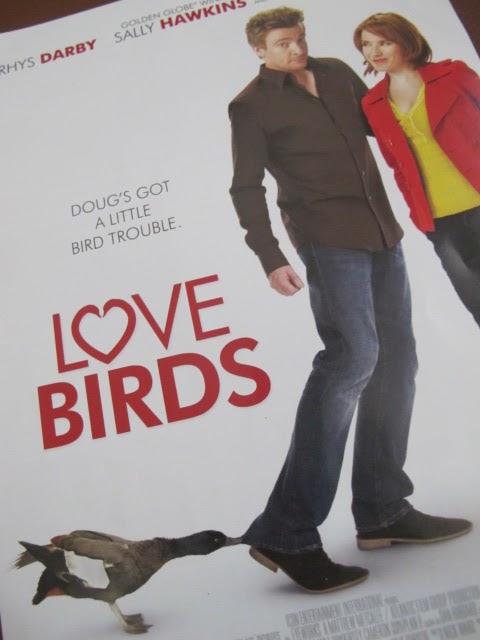
Love Birds and a few others disprove that rather bitchy statement.

The second point I want to make is that last week I undertook to do a kind of mini roundup of Kiwi films on circuit right now, but something rather momentous happened: I was offered three days’ work.

Anyway, Rhys Darby plays Doug Gordon, a freak as far as being a white New Zealander is concerned, and I’m making the racial distinction for a particular reason.

But he’s a freak because he hasn’t done his OE – his overseas experience. This is because he doesn’t like flying, literally and figuratively.

In fact, he might be a bit of a freak as far as the world is concerned too: he’s quite content with his life, as is the wont of many a Kiwi. He loves his girlfriend and the rock band Queen, and he seems to like his job and his workmates, which include another Pakeha, a Sikh and a Maori.

Moreover, he lives in one of the safest, cleanest and most prosperous cities in the world, Auckland, so what’s to be unhappy about? Okay, it might be to hell and gone from the skirts of the mothership, England, as mentioned in the script, but that’s about it.

Darby, who usually plays slightly hysterical characters to good effect, or the officious Murray in Flight of the Conchords, is now required to play a romantic lead and of course we all want to know whether he can play it straight.

Let's just say he takes to it like the proverbial duck. It’s one of the many surprises of this film, which is really just a romantic comedy with its feet, as the visiting Don McClean implied about Kiwis, on the (shaky) ground.

If Doug’s social climber of a partner leaves him rather abruptly at the beginning of the film and he ends up with a real quacker as consolation, then his new romantic interest will have a child, like so many New Zealanders have too. And, like so many Aucklanders, she’s not from here. She’s from the UK.

But to get back to the issue of race: it is touched on by the Sikh guy (What do you call an Indian guy who flies a plane, he asks. A pilot), yet we don’t get to know much about his or his Maori workmate’s life. It’s the other Pakeha who’s also going to have a fling.

One could read all kinds of unnecessary, probably unintended but careless biases into what is, essentially, a light, fluffy comedy. Maybe it would have been better just to leave out that kind of theme - or give these guys slightly more developed characters. They could be married (to each other or others), divorced, whatever.

Right now they’re just background colour, no pun intended, with very little to do.

As for Doug’s romantic interest, Sally Hawkins is not just good at playing a woman who’s had her fair share of life’s little and larger blows, she also does a very sexy screen kiss.

If the film is a bit slow for a romcom and some of the dialogue is a bit forced – surely there’s a more creative way to make a cheerful Bryan Brown imply what a twitcher is – then Love Birds is still a warm-hearted film that will go on to do good business (and let us not forget that film is a business) in its secondary markets of TV and DVD.

Pity it was a week late for Valentine’s Day.

Shock, horror as blogger’s wish list almost matches Oscar winners!

The cynical view would be that The King’s Speech won the most categories (tying with Inception’s technical ones) because America needs to remain on good terms with the UK for the war effort in the Middle East, or maybe it’s that old nostalgia for the Nazi-sympathetic royals.

The good news is that winning screenwriter David Seidler has a Kiwi connection and that you too can win your first Oscar at 72, so keep writing, directing or sewing.

If I’m pleased about being wrong about one thing, then it’s that the documentary Inside Job was taken seriously. It’s time those greedy bastards who caused the recession were exposed for what they are, worldwide.

True Grit and 127 Hours scored nada, deservedly, and The Fighter is still the movie of the year in my book. It even proves that a good director can make a script-by-committee into something shit-hot.

Neil Sonnekus